


Trustworthy Relationships of Integrity
As a globally renowned leader in communication and
entertainment electroacoustic products, Merry is committed
to promoting sustainable supply chain management, viewing
suppliers as important partners. Through stable and close
cooperation with suppliers, we aim to create economic value
while also expecting our supplier partners to jointly adhere
to the RBA Code of Conduct and emphasize social and
environmental responsibility, thereby creating a sustainable
and mutually beneficial supply chain together.
01
Announced Supplier Code of Conduct
02
100% completion on CSR audits
03
achieving 100% conflict minerals-free metals
04
97% signing rate of Social and Environmental Responsibility Commitment
Supply Chain Management
Source management
New Supplier Selection System
When MERRY selects new suppliers, an evaluation team comprising representatives from procurement, quality, R&D, and engineering departments conducts assessments. The evaluation scope encompasses not only basic company information, quality systems, and intellectual property rights as commercial indicators but also thoroughly examines suppliers’ performance in chemical restricted substances management systems, social and environmental sustainability initiatives, labor rights protection, prohibition of conflict minerals, and corporate governance within ESG dimensions. This process identifies risks specific to certain industries or product suppliers. Suppliers must undergo evaluation and receive approval to be included in the qualified supplier list.
Compliance with Sustainability
MERRY adheres to the RBA Code of Conduct requirements and has formulated the''Supplier Code of Conduct'' based on this standard. It covers regulations related to labor,health and safety, environment, business ethics, and management systems. Suppliers are required not only to comply with the Code but also to observe the laws and regulations of their operating jurisdictions. MERRY also encourages suppliers to require their upstream suppliers to adopt this Code. In 2024, MERRY established the ''Conflict Minerals Policy'' to enforce procurement responsibility. Suppliers must utilize smelters certified by the Responsible Minerals Initiative (RMI) to comply with conflict minerals regulations,uphold corporate responsibility for human rights protection, manage suppliers' due diligence programs on conflict minerals, enhance transparency of supplier information,and ensure the company complies with regulatory and customer requirements.
Signing of the Social and Environmental Responsibility Commitment
To fulfill commitments to social and environmental protection responsibilities and to enhance responsible procurement management, the ''Supplier Operational and Environmental Sustainability Commitment'' has been implemented. This document encompasses three key areas: labor conditions, ethical standards,and environmental protection. Suppliers are required to adhere to relevant social responsibilities and prioritize environmental protection, working collaboratively with MERRY to promote a green supply chain.
Suppliers who have not signed the "Commitment to Business and Environmental Sustainability" and the "Declaration on Conflict-Free Metals" are all customer-designated suppliers; excluding customer-designated suppliers, the signing rate is 100%.
Conflict Minerals Management
MERRY declares and commits to not accepting metals sourced from smelters in conflict-affected regions that have not passed responsible sourcing verification. The company also requires suppliers to sign a “Conflict-Free Metal Declaration.ˮ Furthermore, in accordance with the OECD Due Diligence Guidance, we have established conflict minerals management procedures. Using the latest versions of the Conflict Minerals Reporting Templates (CMRT, EMRT) and the MERRY GPMS+MMAP platform system, we conduct investigations into the mineral sources of suppliersʼ materials. By 2025, we aim to complete investigations of 740 suppliers whose products contain minerals such as gold (Au), tantalum (Ta), tin (Sn), and tungsten (W), ensuring 100% traceability to RMI-certified metal smelters.
Note:
Conflict-free minerals/metals refer to minerals not mined in situations involving armed conflict or human rights abuses, specifically those mined by armed groups in the Democratic Republic of the Congo and surrounding areas. These include coltan, stannite, wolframite, cobalt ore, and gold ore. These minerals can be refined into tantalum (Ta), tin (Sn), tungsten (W), cobalt (Co), and gold (Au). Additionally, minerals such as mica (Mica) and cobalt (Co) mined in India and other regions are also classified as conflict minerals. These minerals are critical to the innovation and functionality of audio-electronic products. Gold (Au) is used in circuit boards and connectors to ensure excellent conductivity and corrosion resistance; tantalum (Ta) is used in capacitors to stabilize power storage; and tin (Sn) is used in circuit board soldering.
Conflict-free minerals/metals refer to minerals not mined in situations involving armed conflict or human rights abuses, specifically those mined by armed groups in the Democratic Republic of the Congo and surrounding areas. These include coltan, stannite, wolframite, cobalt ore, and gold ore. These minerals can be refined into tantalum (Ta), tin (Sn), tungsten (W), cobalt (Co), and gold (Au). Additionally, minerals such as mica (Mica) and cobalt (Co) mined in India and other regions are also classified as conflict minerals. These minerals are critical to the innovation and functionality of audio-electronic products. Gold (Au) is used in circuit boards and connectors to ensure excellent conductivity and corrosion resistance; tantalum (Ta) is used in capacitors to stabilize power storage; and tin (Sn) is used in circuit board soldering.
Supplier Auditing
Regular performance monitoring and evaluation of suppliers are conducted through an assessment system covering price, quality, delivery, and service. Performance evaluations are categorized into three levels: A, B,and C. Suppliers with unsatisfactory overall scores or whose incoming material spot checks reveal non-compliance with hazardous substance standards undergo supplier improvement and effectiveness tracking according to a guidance plan. This ensures continuous iterative improvement and a cyclical mechanism to guarantee that suppliers meet MERRY's standards.
Furthermore, MERRY annually reviews and revises its supplier CSR Audit operations based on the latest version of the RBA. Suppliers receiving an audit rating of C must undergo guided improvement prior to re-engagement;a D rating designates a supplier as non-compliant, resulting in the termination of the cooperative relationship.
In 2025, the list of qualified Tier 1 manufacturing suppliers totaled 718, with 417 meeting CSR audit standards, accounting for 82.4% of total procurement value. Among these, key manufacturing suppliers accounted for 28% of audited procurement.
Key Supplier Audit
In 2025, following the "Supplier System Audit Operating Guidelines," 48 key suppliers were identified for ESG sustainability risk audits, and regular review meetings were convened. The average score of supplier audit results was 87.5 points. Of these, 17 suppliers required improvements, all of which have since been completed; following the improvements, all received a rating of B or higher (one of which completed follow-up improvements in Q1 2026). These 48 key suppliers account for 28% of the Group's manufacturing supplier procurement value.
Note:
- Key Supplier Selection Criteria:
—Key Suppliers: Manufacturers (excluding traders and agents) with transaction amounts exceeding 2 million in the previous year.
—High-Risk Material Suppliers: Manufacturers of battery cells, PCBs, metal surface treatments, color boxes, leather goods, wires, plastic/rubber tape printing and coating, hazardous chemicals, etc. - Material suppliers with on-site audit scores above 80 in the previous year and whose audit non-conformities have been closed are exempt from this yearʼs audit.
- Audit ratings are categorized into four levels from A to D, with scores of ≧80, ≧70, ≧60, and <60, respectively.
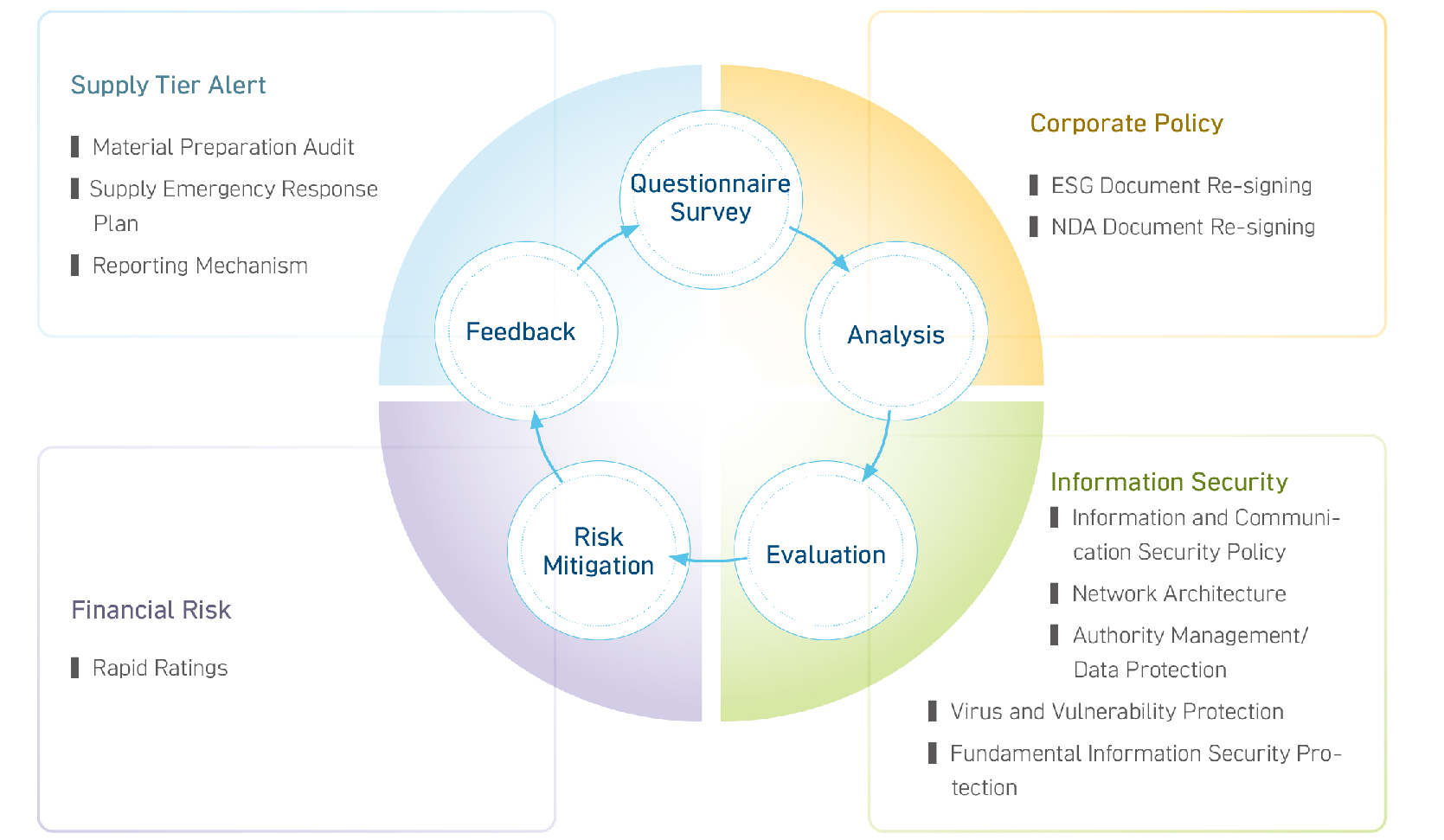
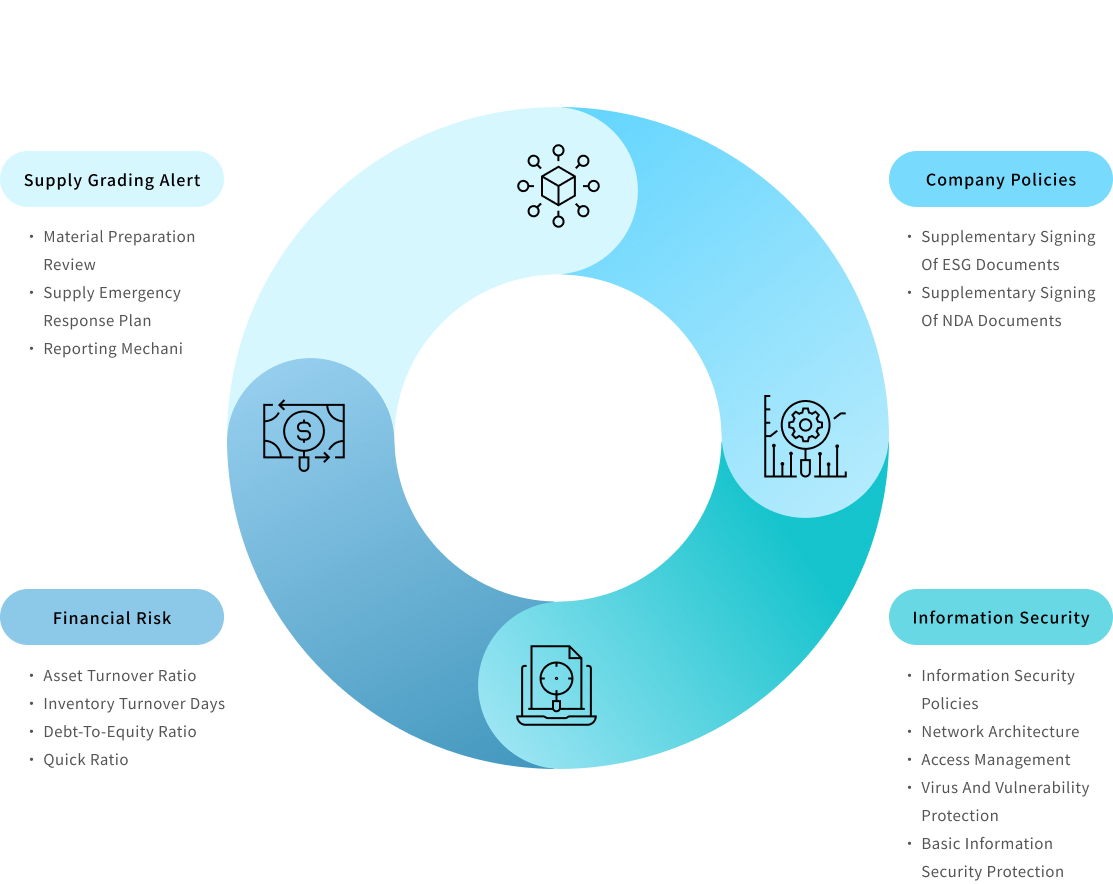
For suppliers with whom we have transactions, we assess them based on different risk evaluation methods (such as critical materials, procurement amounts, customer requirements, etc.). We regularly implement a cyclical management mechanism that includes questionnaire surveys, analysis, evaluation, risk response, and feedback to complete four risk management aspects: "Company Policy," "Financial Investigation," "Information Security," and "Supplier Classification Alerts." This ensures stable monitoring of supplier operations to reduce impacts and losses caused by climate change, pandemics, financial operational crises, and cyber intrusions.
Supplier Risk Management
Supply Grading Alert
In 2025, supply will fully meet customer demand with no abnormalities.
Financial Health Check
MERRY has implemented a third-party financial analysis system—the Rapid Ratings platform—to conduct professional analysis and manage supplier financial risk . In 2025, we expanded third-party supplier outreach risk management to 45 additional suppliers, performing financial health checks (classified into Very Low Risk, Low Risk, Medium Risk, High Risk, and Very High Risk categories) to mitigate operational risks in our partnerships. Survey results indicate that 89% are classified as low risk, 9% as medium risk, and only 2% as high risk (one supplier designated by a client). The one high-risk supplier has been reported to the client, and plans for alternative sourcing are underway. Based on a comprehensive assessment of 2025 financial transactions and service quality, the review concluded that the survey results do not indicate any abnormalities in production or operations.
Information Security Assessment
Conducted by the Information security promotion team in accordance with ISO 27001 standards, establishing five key dimensions (Information Security Policy, Network Architecture, Authority Management/Data Protection, Virus and Vulnerability Protection, and Fundamental Cybersecurity Measures) as assessment criteria. This includes a comprehensive evaluation of industry cybersecurity risks and supply chain disruption risks, effectively identifying and preventing information security incidents originating from suppliers, thereby mitigating the capacity risk impact assumed by MERRY. In 2025, a tiered evaluation (Grades A, B, C) was conducted on 40 Key Suppliers regarding risks associated with access to organizational assets; no anomalies were identified.
Localization
MERRY enhances supply chain flexibility and resilience while reducing the carbon footprint impact of transportation. The company actively develops suppliers in the regions where its operational sites are located, maintains supply chain diversity,and implements a localized procurement strategy. Additionally, MERRY continuously monitors whether climate change or unexpected natural disasters in supplier locations might affect production or transportation, ensuring stable supply through short-chain sourcing and local services. In 2025, MERRY will implement a procurement risk diversification strategy to enhance regional responsiveness, expand its plants in Thailand and Vietnam, and provide diverse manufacturing solutions.
MERRYʼs client base consists primarily of major international manufacturers, with electronic components for international brands accounting for as much as 95% of its total. Consequently, electronic materials are predominantly imported. By 2025, the proportion of local procurement at its Chinese facilities had risen to 55%, representing a 7% increase from 2024, while local procurement of non-electronic components reached 99%; at its Southeast Asian facilities, the proportion of local procurement stood at 8.8%. Regarding the supply chain, the company has actively implemented the “China+ˮ policy since 2023, collaborating with strategic suppliers to develop production plans outside of China and accelerate the goal of local procurement. Specifically, local procurement of key mechanical components—plastic parts—at the Thailand facility has increased by more than 10%, while local procurement of wiring harnesses at the Vietnam plant has increased by more than 5%.
Looking ahead, MERRY will assist more structural component suppliers in establishing factories in Southeast Asia, taking supply resilience into consideration. It is anticipated that by 2028, a structural component industrial cluster will begin to take shape, enabling short supply chains and diversified configurations, and establishing a supply chain system that respects the environment and supports sustainable development.

Communication and Development
During the product project development phase,MERRY's R&D unit, procurement unit, customers, and suppliers collaborate to discuss issues and share technologies,resolving bottlenecks at each stage and assisting suppliers in process and quality optimization.
Furthermore, to collaboratively advance sustainability initiatives,we strengthen connections and interactions with supplier partners through strategic supplier meetings, the Green Academy, and the SCM supplier information exchange platform. This facilitates bidirectional communication and dialogue with supplier partners, enhancing mutual cooperation, tacit understanding, and consensus, thereby continuously progressing towards sustainable development.
Green Academy
Since 2022, MERRY has continuously implemented supplier development and training. In 2025, three online Green Academy sessions were conducted for first-tier material manufacturers, with a total of 409 suppliers participating.Through courses covering green product specifications,international ESG development trends, and environmental regulations, ESG management concepts are promoted and advocated to key suppliers, thereby advancing MERRY’s sustainability strategy and policies related to green supply chain management.
Other Key Green Supply Chain Cases
In recent years, issues such as environmental protection and carbon reduction have garnered significant attention.MERRY has also been actively collaborating with its key suppliers to work together for a greener planet. For example, we have partnered with suppliers to develop “high-performance recycled engineering plasticsˮ and“general-purpose recycled plastics,ˮ ensuring that even when using recycled plastic materials, we can still provide customers with the exceptional structural strength and durability they require.