Trustworthy Relationships of Integrity

As a globally renowned leader in communication and entertainment electroacoustic products, Merry is committed to promoting sustainable supply chain management, viewing suppliers as important partners. Through stable and close cooperation with suppliers, we aim to create economic value while also expecting our supplier partners to jointly adhere to the RBA Code of Conduct and emphasize social and environmental responsibility, thereby creating a sustainable and mutually beneficial supply chain together.
01
Announced Supplier Code of Conduct
02
100% completion on CSR audits
03
achieving 100% conflict minerals-free metals
04
97% signing rate of Social and Environmental Responsibility Commitment
Customer Rights Protection Policy
MERRY primarily serves international brand clients. Although it does not directly engage with end consumers, it fully acknowledges that product quality and safety ultimately affect the brand customerʼs market reputation and the end consumerʼs experience. Therefore, MERRY has established comprehensive policies to protect Customer rights,ensuring that every phase—from product design and raw material selection to manufacturing processes and after-sales service—safeguards Customer interests and indirectly upholds the health and safety of the End Consumer.
Policy Projects Policy content


Product and Service
Safety Assurance


  1. Environmental Substance Control Management:
    The ''Environmental Substance Control Management Measures'' rigorously regulate product materials and components to ensure that restricted substances do not exceed legal standards, thereby safeguarding the health of the End User.
  2. Product Design Safety Specifications:
    The MERRY‘s ''Security Commitment Letter'' integrates safety considerations during the product design phase to ensure that the product does not cause harm to users under normal operating conditions.
  3. Information Security Management:
    The''Classified Product Safety Management Procedures'' safeguard customer confidential information and intellectual property, preventing unauthorized disclosure and protecting customer business interests.
Customer Service and
Communication Mechanism
  1. Regular Satisfaction Surveys:
    The ''Customer Satisfaction Survey Procedures'' are conducted annually to systematically gather customer feedback and convert the results into specific improvement actions.
  2. Quality Abnormality Communication Mechanism:
    The communication process between CQM and the Customer, as stipulated in the "After-Sales Service and Customer Complaint Handling Procedures,"ensures timely notification to the Customer and the implementation of appropriate measures upon detection of quality abnormalities.


Customer Complaint
Handling Mechanism


  1. Tiered Handling Process:
    The "Customer Complaint Handling Procedures" classify complaints by severity to ensure the reasonable allocation of resources and prioritize the resolution of critical issues.
  2. Product Return, Exchange, and Recall:
    The product recall process outlined in the "Customer Returned Goods Handling Procedures" and the "After-Sales Service and Customer Complaint Handling Procedures" establishes a comprehensive return, exchange, and recall mechanism, enabling prompt action when necessary to minimize the impact on Customers and End Consumers.
 

Customer Complaint Handling Procedure

Process Steps Content Description


Complaint Reception
and Initial Processing


The Sales Department is responsible for receiving customer complaints and must complete the “Customer Complaint Handling Formˮ within 24 hours.

Cause Analysis
and Discussion

The Quality Planning Management Department (QPM) convenes relevant departments to form a project team to jointly analyze the root cause of the issue and discuss corrective actions.


Temporary Corrective
Action Response


The Product Quality Engineering Department (PQE) is responsible for providing the Customer with a temporary corrective action within 3 Working Days upon receipt of the complaint.

Permanent Corrective
Action Formulation

The Product Quality Engineering Department (PQE) must complete the root cause analysis and propose a permanent solution within 7 Working Days, providing a formal response to the Customer. If the issue is complex and cannot be resolved within the stipulated time, an email must be sent to the Customer explaining the current status and the expected completion time, thereby maintaining transparent communication.

Corrective Action
Implementation
and Follow-up

The Sales Department and The Quality Planning Management Department (QPM) are jointly responsible for executing the corrective actions and monitoring their implementation to ensure the effectiveness of the solution.

Case Closure
Confirmation

The Product Quality Engineering Department (PQE) is responsible for confirming with the customer within 7 working days after the implementation of corrective actions whether the case can be closed, and for collecting the customerʼs satisfaction evaluation of the solution.

Standardization
and Prevention

The Product Quality Engineering Department (PQE) monitors relevant departments to establish successful solutions as standard operating procedures,integrating them into the Quality Management System.

Customer Satisfaction
In addition to proactively conducting an annual satisfaction survey before the first quarter each year, MERRY also employs a scorecard mechanism (Score Card) for supplier evaluation by customers to assess their feedback, opinions, and requirements regarding MERRY. Relevant information is consolidated and analyzed to identify root causes, propose improvement plans, and actively promote implementation and subsequent follow-up on outcomes.
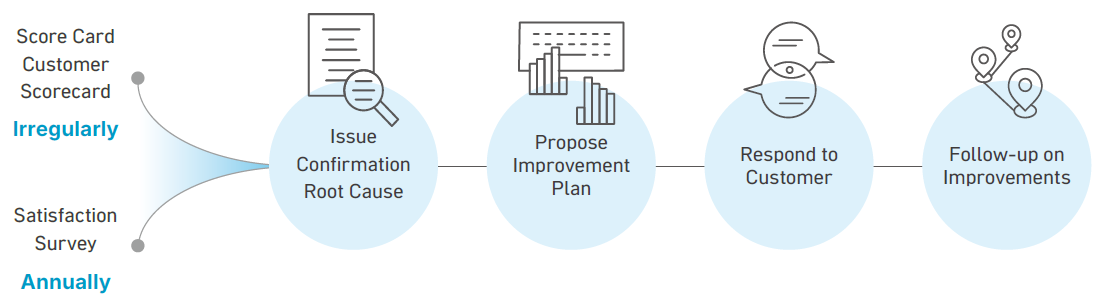
 
Customer Satisfaction  
The satisfaction survey and scorecard mechanism cover four key dimensions: Quality, Research and Development, Procurement, and Integration. These serve as essential reference indicators for improving subsequent related operations and business activities. After consolidating various issues, they are forwarded to the responsible units for root cause analysis and the submission of improvement plans within a specified timeframe. In addition to responding to the customer, the matters are also assigned to the audit and marketing departments for subsequent follow-up and improvement. The comprehensive satisfaction score for major Customers in 2025 (accounting for 53.5% of revenue) was 79.47 points, a decrease from 87.73 points in 2024.
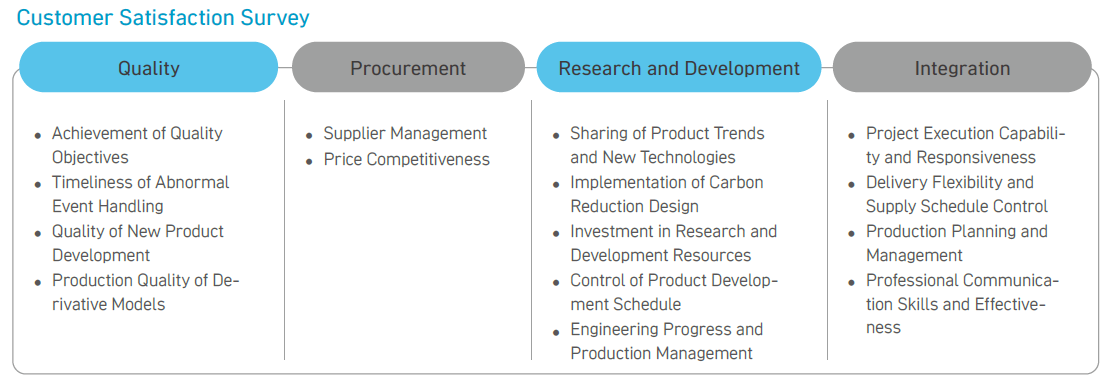
Customer Satisfaction Survey
Digital Transformation
All industries face the challenge of accelerating the speed at which information is conveyed to customers. Companies must respond to this era of rapid change by accelerating their investment in comprehensive digital transformation. MERRY initiated its digital transformation in 2021, introducing innovative models such as process robots in production management and the digitization of global supply chain management. Through digital optimization, we have also strengthened customer relationship management. Given MERRYʼs high customer concentration, we have implemented two-way electronic data interchange (EDI) with clients based on revenue share and transaction frequency to optimize service processes.
Quality Management System
MERRY has achieved ISO 9001:2015 Quality Management System certification, establishing a systematic product development process to ensure that new products meet customer requirements regarding quality, cost, and delivery time, while continuously optimizing to enhance product competitiveness. The quality assurance system involves cross-departmental collaboration among Research and Development, Quality Management, Sales, manufacturing sites, and supply chain management, and optimizes quality management and customer service through a cyclical process of planning, implementation, inspection, and improvement.
Critical Material Management Process
To enhance new project development efficiency and customer satisfaction, MERRY has established the "Critical Material Definition and Operational Procedures" to identify and control key components affecting production quality, ensuring quality, delivery schedule management, and mass production quality at every stage.
1.RFQ Phase 2.DVT Phase 3.PVT Phase
  • Component Engineering: Define the "Critical Component List."
  • Project Management: Confirm critical material details with the Customer.
  • Research and Development: Conduct risk material assessment.
  • Procurement: Confirm and provide information on long lead-time materials.
  • Sales: Confirm Customer-selected material details.
  • Component Engineering: Adjust the "Critical Component List."
  • Project Management: Provide feedback on critical material details to the Customer.
  • Quality Project Management: Adjust the material preparation status.
  • Procurement: Monitoring Long Lead-Time Material Status.
  • Supplier Quality Management: Verification of Incoming Material Issues.
  • Quality Project Management: Control of Material Quality.
  • Supplier Quality Management: Supplier Material Quality Control.
  • Incoming Material Inspection: Control of Material Yield Rate.
  • Procurement: Monitoring Material Status at Each Stage.
 
Back

Verification

Click the numbers in sequence.

依據歐盟施行的個人資料保護法,我們致力於保護您的個人資料並提供您對個人資料的掌握。
按一下「全部接受」,代表您允許我們置放 Cookie 來提升您在本網站上的使用體驗、協助我們分析網站效能和使用狀況,以及讓我們投放相關聯的行銷內容。您可以在下方管理 Cookie 設定。 按一下「確認」即代表您同意採用目前的設定。

Privacy preferences

依據歐盟施行的個人資料保護法,我們致力於保護您的個人資料並提供您對個人資料的掌握。
按一下「全部接受」,代表您允許我們置放 Cookie 來提升您在本網站上的使用體驗、協助我們分析網站效能和使用狀況,以及讓我們投放相關聯的行銷內容。您可以在下方管理 Cookie 設定。 按一下「確認」即代表您同意採用目前的設定。

Manage preferences

Necessary cookie

Always on
網站運行離不開這些 Cookie 且您不能在系統中將其關閉。通常僅根據您所做出的操作(即服務請求)來設置這些 Cookie,如設置隱私偏好、登錄或填充表格。您可以將您的瀏覽器設置為阻止或向您提示這些 Cookie,但可能會導致某些網站功能無法工作。

Functional cookie

這些 Cookie 允許提供增強功能和個性化內容,如視頻和實時聊天。我們或我們已將其服務添加至我們頁面上的第三方提供者可以進行設置。如果您不允許使用這些 Cookie,則可能無法實現部分或全部功能的正常工作