
Creating Positive Environmental Impact
Merry actively addresses the environmental and resource issues brought about by climate change.


- Implement group greenhouse gas (Scope 1–3) inventory to accurately monitor greenhouse gas emissions
- Implement Science-Based Targets(SBT): controlling warming within 1.5°C for scope 1 and 2, and below 2 ° C for scope 3 as the group’s decarbonization
goal scenario
- Adopting the GHG Protocol standard, the greenhouse gas inventory forall entities in the consolidated report has been completed and verified by SGS as a third party.
- Greenhouse gas emissions from scope 1 and scope 2 have been reduced by 2.34% compared to the Base Year 2023.
- Greenhouse gas emissions from scope 3 have been increased by 315% compared to the Base Year 2023.
- By 2032, scope 1 and scope 2 emissions will be reduced by 50.4% compared to 2023; scope 3 emissions will be reduced by 30%.
- Achieve group-wide carbon neutrality by 2040.
- Greenhouse gas emissions from scope 1 and scope 2 have been reduced by 17% compared to the Base Year 2023.
- Greenhouse gas emissions from scope 3 have been reduced by 7.5% compared to the Base Year 2023.
- Expand energy-saving initiatives: conduct an inventory of energy equipment to enhance efficiency; study successful corporate cases to acquire relevant
energy-saving insights. - Energy monitoring aystem and usage analysis: collect energy consumption data via the system and analyze energy consumption hotspots.
- Energy intensity in 2025 increased 39.04% compared to the base year.
- 2025 Energy Intensity: 3.32, an increase of 9.73% compared to the 2023 baseline.
- Quantifiable energy-saving initiatives are projected to achieve annual electricity savings of approximately 805,521 kWh, with total electricity cost savings of approximately NT$2,670,000.
2025 Statistics
| Energy-saving project categories | Number of Initiatives | Annual Electricity Savings (kWh) | Cost (NTD) |
| Energy Management Systems |
3 |
646,440.00 | 1,681,960 |
| Lighting Systems | 2 | 77,683.52 | 317,224 |
| Process and Other Equipment | 2 | 3,000.00 | - |
| Power Systems | 1 | 78,398.00 | 671,250 |
| Total | 8 | 805,521.52 | 2,670,434 |
- By 2032, achieve a 50% reduction in energy consumption and improvements compared to the Base Year 2023.
- Implement a smart, integrated energy management system to ensure continuous improvement in energy efficiency.
- Energy Management and Energy Improvement 2% reduction compared to the Base Year 2023.
- Strengthen the energy management system and continue to promote equipment energy efficiency optimization.
- Direct use of renewable energy: Assess the installation of solar power generation systems and renewable energy supply schemes.
- Purchase renewable energy certificates: Support local renewable energy development through the acquisition of renewable energy certificates.
- Evaluate Power Purchase Agreements(PPAs).
- In 2025, MERRYʼs RE100 commitment encompassed the use of 28,132 MWh of renewable electricity, representing 61.83% of total electricity consumption; Of this, 12,990 MWh was direct use of renewable electricity, while the remaining 15,142 MWh was procured through the purchase of renewable energy certificates.
- Compared to 2024, the share of renewable energy usage increased by 43.42%.
- By 2030, renewable energy will constitute 100% of total energy consumption.
- By 2026, renewable energy will constitute 65% of total energy consumption.
- Continuing to focus on customer demand for renewable energy.
- Expand self-generated solar capacity.
- Establish Shadow Pricing by setting an internal carbon price to assess potential future regulatory and transition risks related to climate change that the organization may encounter.
- The Taiwan Headquarters has implemented an internal carbon pricing mechanism, adopting a shadow carbon price system integrated into investment benefit assessments.
- Completed the planning of short-, medium-, and long-term targets and promotion schedules for implementing the internal carbon pricing mechanism across all operational sites.
- Introduced an internal carbon fee mechanism to enhance organizational awareness of carbon reduction.
- Ongoing internal promotion and implementation of the shadow carbon price and continuous optimization of operational processes.
Water Resources
- Use ISO 14001 as the management foundation
- Installing water-saving equipment
- Improve water use efficiency
Waste
- Managed in accordance with ISO 14001
- Regularly monitor hazardous waste emissions from factories
- Analyze anomalies in real time and implement continuous improvements
Water Resources
- Water Use Intensity in 2025 decreased by 12.72% compared to the Base Year 2023.
- Both METC and MEVN achieved their water conservation targets by adjusting domestic water usage.
Waste
- 100% compliance with local regulations and standards for waste management.
- Waste intensity increased by 156.09% compared to the Base Year 2023.
- UL 2799 certification obtained by Taiwan Headquarters, MECL, and MEVN.
- MECL and MEVN achieved UL 2799 Gold-level certification.
Water Resources
- By 2032, Water Use Intensity will decrease by 30% compared to 2023.
- Strengthen water usage monitoring and improve water efficiency.
Waste
- By 2032, Waste Intensity will decrease by 30% compared to 2023.
- Major production sites have completed UL 2799 certification.
- Implement source-separated waste management and recycling to continuously reduce waste.
Water Resources
- Water use intensity decreased by 16% compared to the Base Year 2023.
Waste
- Waste intensity decreased by 16% compared to the Base Year 2023.
- Continue to implement the UL 2799 management procedures.
| Year | Renewable Energy Planning and Energy Management | Greenhouse Gas Management |
|---|---|---|
| 2024 |
|
|
| 2025 ~ 2026 |
|
|
| ~ 2030 |
|
|
| 2040 |
|
|
Strengthen Corporate Sustainability Principles
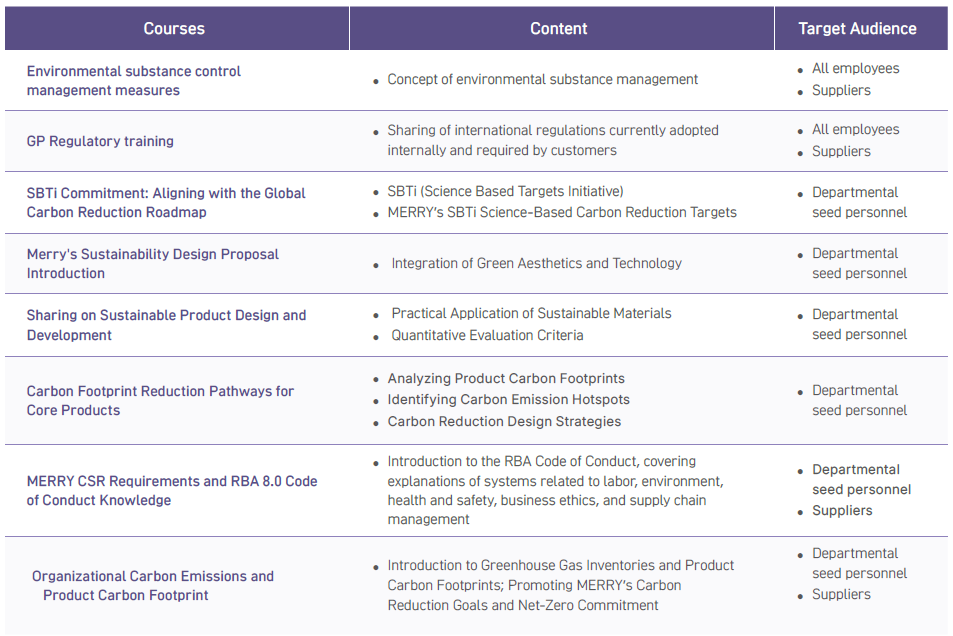
To deeply embed the concept of corporate sustainability, MERRY has made environmental protection a core component of training for new hires and departmental representatives, actively fostering employeesʼ sense of environmental responsibility and implementing it across operational processes such as product design, raw material control, and greenhouse gas emissions management. We also regularly educate suppliers on the "Environmental Substance Control Management Measures" and international environmental regulations, extending our green policies to supply chain partners. We aim to foster a green supply chain and achieve the goal of sustainable corporate operations. In 2025, environmental training reached approximately 3,990 participants, totaling about 4,026 hours, demonstrating MERRYʼs concrete actions to deepen sustainability awareness.